

If you manage Microsoft 365 every day, you already know where time goes. It goes into checking service health, finding licensing gaps, reviewing configuration settings, handling support requests, and jumping between admin centers. Copilot in Microsoft 365 admin centers is designed to reduce that overhead by giving admins a single AI-assisted surface to ask questions, review recommendations, and move faster across admin workflows.
This is not just another marketing feature. Microsoft now provides Copilot experiences inside Microsoft 365 admin centers so admins can use natural language to get answers, summarize tenant information, review users and groups, understand service incidents, and access scenario-based guidance across Microsoft 365 workloads.
What Is Copilot in Microsoft 365 Admin Centers?
Copilot for admins is an AI experience built into Microsoft 365 admin centers. It helps administrators work across Microsoft 365 services using natural language, contextual recommendations, and admin-focused summaries. In supported tenants, admins can launch Copilot from the Microsoft 365 admin center and some specialized admin centers such as Teams, SharePoint, and Exchange.
What Copilot Can Help Microsoft 365 Admins Do
Based on my research, Copilot for admins can help with several practical tasks:
- Generate an admin recap across areas like Service Health, Message Center, and Groups.
- Answer admin questions such as how to restore a deleted user, review Copilot usage, or configure MFA.
- Surface service health signals and recommendations for Microsoft 365 workloads.
- Search users and groups with natural language and export results for further review.
- Access Microsoft 365 Admin agent capabilities through Microsoft 365 Copilot Chat when licensing and role requirements are met.
What’s New and Different in 2026
The Copilot experience for Microsoft 365 admins has evolved significantly, and it’s important to reflect the current structure rather than older terminology or assumptions. One of the key changes is the shift away from the “Endpoint Manager” name, which is no longer used in modern admin guidance. The correct and current platform is Microsoft Intune, and its AI capabilities are now aligned with the broader Security Copilot ecosystem, not the same experience you see inside the Microsoft 365 admin center.
Another important evolution is how access and roles are handled. Copilot is not a single, uniform feature—it behaves differently depending on the admin role and the task being performed. Some roles allow full interaction and configuration of Copilot scenarios, while others are limited to viewing insights and summaries. In practical terms, this means administrators need to understand their assigned roles clearly before expecting full access to Copilot features across the environment.
There is also a difference between using Copilot directly inside the admin center and accessing it through Microsoft 365 Copilot Chat. In the admin center, Copilot can be available with basic tenant-level enablement, but advanced interactions—such as using the Microsoft 365 Admin agent—require additional licensing and proper role assignment. This distinction is critical but often missed in many existing blogs.
Licensing and Prerequisites You Should Include
Copilot for Microsoft 365 is not a standalone product—it is an add-on capability layered on top of existing Microsoft 365 or Office 365 subscriptions. This means organizations must already be using a supported base plan before they can enable Copilot features.
For end-user and admin-level experiences, there are a few practical requirements that need to be in place. Users must have a valid identity in Microsoft Entra ID, and their primary workloads—such as email and collaboration—should be running in cloud services like Exchange Online. This is because Copilot relies heavily on organizational data signals to generate relevant insights and responses.
From a technical standpoint, environment readiness also plays a role. Modern browsers, proper network configurations, and access to required service endpoints are necessary to ensure a consistent Copilot experience. Without this baseline, even properly licensed users may face limitations.
Beyond licensing and infrastructure, there is also an operational aspect. Organizations that get the most value from Copilot are the ones that have already structured their data environment properly—this includes well-managed SharePoint permissions, clean data access policies, and clear governance controls. These foundations directly impact how useful Copilot responses are in real-world scenarios.
Real-World Scenarios Where Copilot Helps Admins
1. Admin recap and faster triage
Instead of opening Message Center, Service Health, and user reports separately, an admin can ask Copilot to summarize what matters right now. This is useful at the start of the day or before a leadership update.
2. User and group investigations
Admins can use natural language prompts to find users by condition, group ownership, or service usage patterns. This is especially helpful when investigating adoption, support cases, or access cleanup tasks.
3. Teams-focused troubleshooting
Teams has its own Copilot-related admin guidance. Microsoft notes that Teams AI-based capabilities depend on licensing, Teams Rooms setup, and supporting features such as transcription, recording, and related policy settings. This means Teams scenarios should be described carefully instead of implying that Copilot automatically fixes every meeting problem.
4. Intune context and device troubleshooting
If you want to mention Intune, position it correctly. Copilot in Intune is tied to Microsoft Security Copilot and can help admins review policies, understand security posture, and troubleshoot device issues. This is valuable, but it should not be presented as the exact same Copilot experience as the Microsoft 365 admin center shell.
How Does Copilot Work Behind the Scenes?
- Data models: It reads signals from your tenant—usage data, policies, health.
- Microsoft Graph: Taps into real-time data securely.
- Natural Language AI: Translates your query into actionable commands.
- Security & Compliance: Honors role-based access control (RBAC).
Where Can You Use It Today?
Currently available in:
More integrations are on the way!
How to Access Copilot as an Admin
- Sign in to the Microsoft 365 admin center or a supported specialized admin center.
- Select the Copilot button if the feature is available in your tenant.
- Use plain-language prompts to ask for tenant help, service-health context, user results, or guidance.
- For Microsoft 365 Copilot Chat, add the Microsoft 365 Admin agent if your role and license support it.
No PowerShell, no scripts—just plain language and fast action.
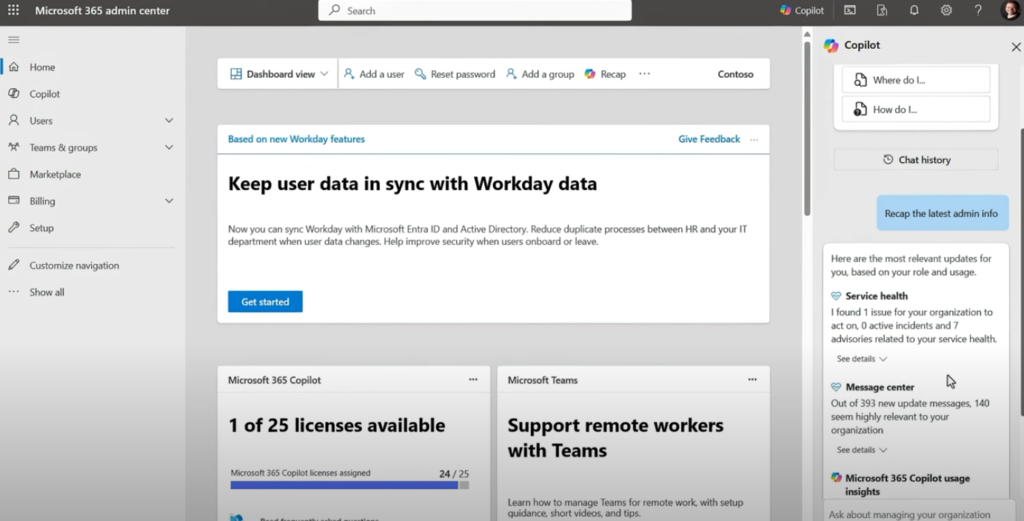
Just make sure that at least one Copilot license is assigned to a user in the tenant.
Pro Tips for Microsoft 365 Admins
- Use it daily for user management, license checks, and policy reviews.
- Try automation for repetitive tasks like onboarding or license cleanup.
- Report smarter – Let Copilot summarize trends and generate visuals.
Security and Governance Considerations
When it comes to Copilot, security is not a separate feature—it is built on top of your existing Microsoft 365 permissions model. Copilot does not introduce new access levels; it works within the boundaries of the roles and permissions already assigned to users and administrators. This means that any response generated by Copilot is limited to what the user is already allowed to see within the tenant.
Because of this, role management becomes even more important. Instead of assigning broad administrative access by default, it’s better to follow a controlled approach where each admin role is aligned with specific responsibilities. This not only reduces risk but also ensures that Copilot outputs remain relevant and scoped correctly for each admin task.
Another key factor is how your organization handles data governance. Copilot relies heavily on the data stored across Microsoft 365 services such as SharePoint, OneDrive, Exchange, and Teams. If access to this data is overly broad or not properly structured, Copilot may surface information that is technically accessible but not operationally appropriate.
To avoid this, it is important to maintain clean and well-defined data boundaries. This includes managing SharePoint permissions carefully, ensuring content ownership is clear, and avoiding unnecessary access inheritance across sites and libraries. Well-structured access control directly improves the quality and safety of Copilot-generated insights.
Data classification also plays a critical role. When information is properly labeled and categorized, it becomes easier to control how it is accessed, shared, and surfaced through AI-driven tools. Without this structure, Copilot responses can become less precise and harder to govern.
Finally, governance is not just about configuration—it’s also about rollout strategy. Introducing Copilot gradually, validating results with real admin scenarios, and refining access patterns based on actual usage leads to a much more controlled and effective adoption.
Summary: Why Copilot Will Change Your Workflow
Copilot in Microsoft 365 admin centers is a valuable addition for IT teams, but its real impact comes from how it is used in day-to-day operations. Rather than replacing administrative expertise, it works best as a productivity layer that helps streamline support tasks, improve visibility, and simplify routine configuration reviews.
In its current state, Copilot delivers the most value when paired with a clear understanding of where it is available, what tasks it can realistically support, and how access and licensing are structured within the tenant. Admins who approach it with the right expectations will find it useful for reducing manual effort and gaining quicker insights across Microsoft 365 services.
FAQs
Q1. What is Copilot in Microsoft 365 Admin Center?
A: Copilot is an AI assistant that helps admins perform tasks, analyze data, and automate actions using natural language.
Q2. Can I use Copilot to manage licenses in Microsoft 365?
A: Yes! Copilot can identify inactive users, recommend license optimization, and even start cleanup workflows.
Q3. Is Copilot secure for enterprise use?
A: Absolutely. It respects your admin roles, uses RBAC, and adheres to Microsoft’s compliance standards.
Q4. What kind of tasks can I perform with Copilot as an M365 Admin?
A: From checking user activity to managing MFA, fixing Teams issues, or optimizing usage—Copilot helps with it all.
Q5. Is Copilot available in all Microsoft 365 tenants?
A: It’s rolling out to eligible tenants. Check your admin center for availability or reach out to Microsoft support.
Explore More from MS Cloud Explorers
- Microsoft Viva Insights: The Ultimate Guide to Boost Productivity and Wellbeing
- The Ultimate Guide to SharePoint: Create a Stunning Site Template and Lock Down Permissions
- How to Send Encrypted Email in Outlook: A Step-by-Step Guide for Beginners
- How to Deploy the ChatGPT and Microsoft Store Apps Using Microsoft Intune (Step-by-Step Guide)
- Endpoint Privilege Management in Intune: Complete Guide for Secure Admin Elevation (2026)
- How to Create and Manage Microsoft Attack simulation training in Microsoft 365 (2026)
- Microsoft 365 Compromised Account Recovery: Complete Admin Guide (2026)
We’d love you to stay connected!
Keep up with the latest Microsoft Cloud news, updates, and learning resources from MS Cloud Explorers.
🔗 Explore Renewal Tests at mscloudexplorers.com/learn
📘 Explore all Microsoft 365 & Intune blogs at mscloudexplorers.com/blog
📰 Join our newsletter to get the latest Microsoft Cloud news and updates directly in your inbox.
🔔 Follow us on LinkedIn for announcements, tips, and community insights.
Clear and insightful overview of Copilot for Microsoft 365 admins! The walkthrough on using AI insights, natural‑language prompts, and task automation is really helpful. It’d be great to also include a comparison of Copilot vs. traditional admin tools (like Message Center, PowerShell alone). Thanks for making this complex topic digestible!
Thanks for the feedback—I’m glad you found the guide valuable! Excellent suggestion—I’ll add a section comparing Copilot-powered admin features with standard tools like Message Center summaries and PowerShell scripts. Should help readers understand when AI adds the most value. Appreciate your comment!